KB Home Financial Planning & Performance Analysis
Cost Accounting · Indiana University · 2024
FP&A · Budgeting · Forecasting · Variance Analysis
Overview
This project was completed as part of my Cost Accounting coursework at Indiana University. Our six-person team was assigned KB Home as a real-world company to analyze, with the goal of using its historical financial performance and publicly available data to build a more informed budget and evaluate how management could better measure performance.
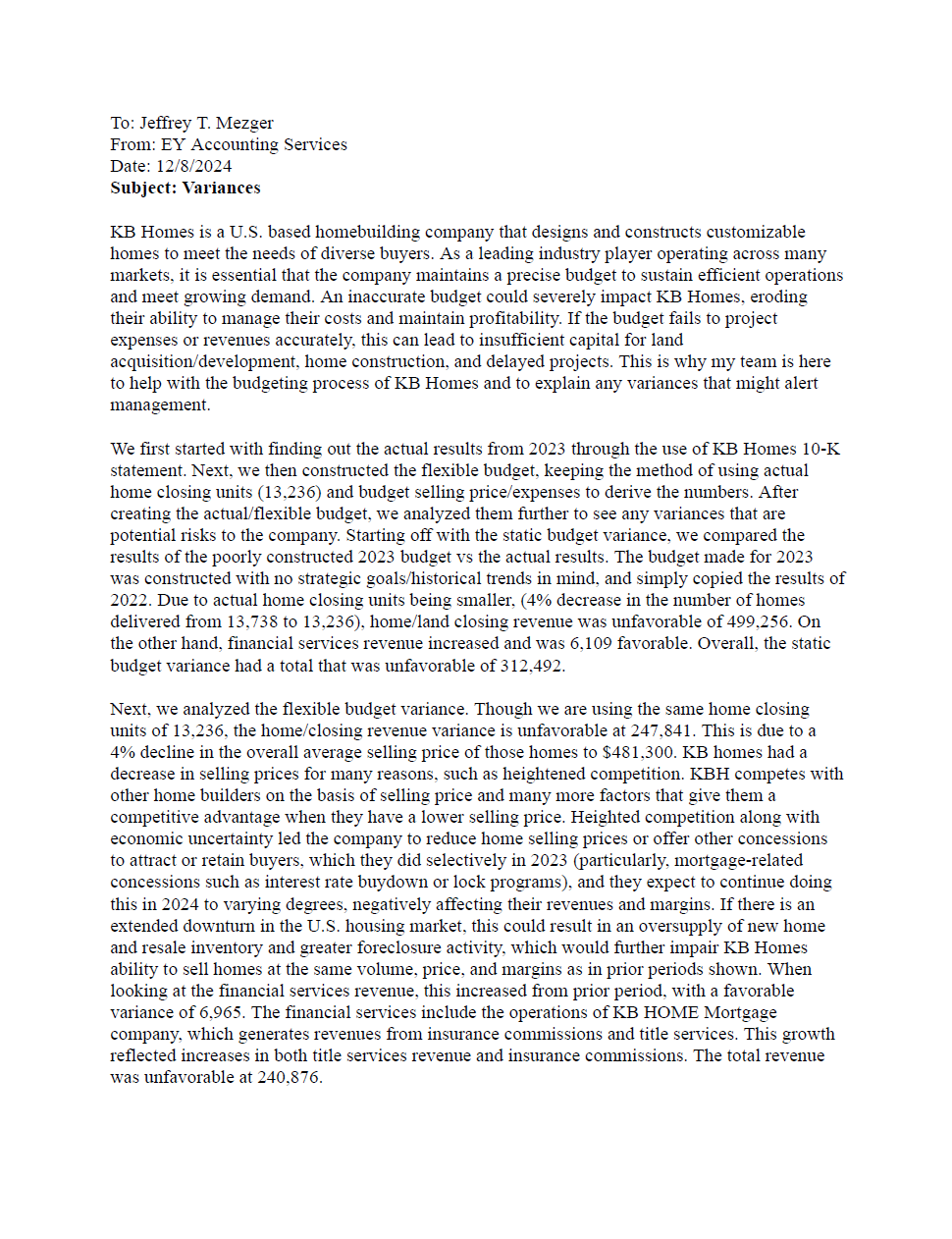
The project began by comparing KB Home’s 2023 actual results against its original budget. We used static, flexible, and sales-volume variance analysis to understand why actual performance differed from expectations and to separate the effects of changes in sales volume, selling prices, costs, and other operating factors.
From there, we shifted from explaining past performance to planning for the future. We built regression models to forecast home closings, selling prices, construction costs, and SG&A expenses, then brought those forecasts together into a budgeted FY2024 income statement. The final part of the project looked at divisional performance and compared residual income and ROI as measures for evaluating and compensating managers.
Analysis
Our variance analysis showed that KB Home’s performance was affected by a combination of lower home closings, declining average selling prices, rising construction costs, inflationary pressure, and higher selling and administrative expenses. The West Coast segment experienced the largest decline in home deliveries, while other regions partially offset that weakness. This helped us separate the effects of lower sales volume from differences in pricing and costs rather than treating the total variance as a single problem.
For the FY2024 budget, we used historical company data alongside external market indicators to build several regression-based forecasts. Ending backlog was used to estimate future home closings, the U.S. Home Price Index was used to forecast average selling prices, construction wages were used to estimate home closing costs, and revenue was used to forecast SG&A. These estimates were then combined with forecasts for KB Home’s financial services operations to create the final budgeted income statement.
The project also looked at how KB Home evaluates its regional divisions. We found that using companywide residual income as a benchmark could be misleading in a capital-intensive business where large amounts of land, homes under construction, and other operating assets are carried on the balance sheet. We therefore compared the results with ROI and considered how different performance measures could affect management incentives across the company’s regions.
Recommendations
Use forecast-driven budgeting and ROI to provide a clearer view of operating performance.
Our analysis showed the value of building a budget around the factors that actually drive KB Home’s results rather than simply carrying forward prior-year performance. The forecasted budget used relationships between backlog, home prices, labor costs, revenue, and other operating factors to provide management with a more informed view of the coming year while recognizing that these models would still be affected by conditions not captured in the data.
For performance evaluation, our team recommended using ROI as the primary company measure rather than relying on companywide residual income. ROI produced results that were more consistent with the differences we observed between KB Home’s regional divisions, particularly the weaker performance of the West Coast segment. We also recommended that, where residual income continued to be used, benchmarks should reflect differences between individual regions rather than applying the same companywide comparison to every division.
Please click on the images to access the full content.
Meet the Team
-
![Meshari AlAdwani]()
Meshari AlAdwani
-
![Andrew Davey]()
Andrew Davey
-
![Aryan Mansharamani]()
Aryan Mansharamani
-
![Preston Watt]()
Preston Watt
-
![Justin Wohrle]()
Justin Wohrle
-
![Neha Vijay]()
Neha Vijay